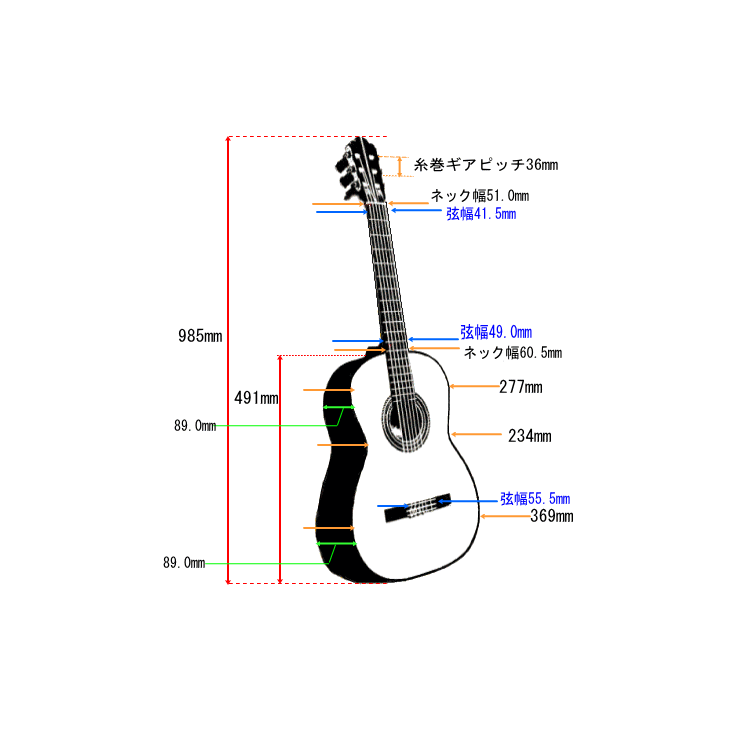
Neck:Mahogany
Fingerboard:Ebony
Finish(Top):Shellac
Finish(Back & Sides):Shellac
Tuning Machines:Unknown
String Height(1st):3.0mm
String Height(6th):3.6mm
【A Rare 1930 Madrid Guitar from the Manuel Ramírez Tradition】
〔Luthier〕
Modesto Borreguero Ortega (1893–1969) was born in Madrid, Spain. At the age of twelve he entered the workshop of Manuel Ramírez as an apprentice and later became one of the important craftsmen of the shop, working alongside makers such as Santos Hernández and Domingo Esteso. After Manuel Ramírez passed away in 1916, Borreguero continued working in the workshop until it closed in 1923.
He opened his own workshop in 1924, though his early independent years were marked by considerable hardship. Poor working conditions, frequent relocations, the Spanish Civil War, and personal tragedies all made his career difficult. Despite these challenges, he continued building guitars in Madrid.
In 1948 he worked in a space provided by Hernández y Aguado, who were at that time restoring furniture. Watching Borreguero’s work closely inspired them to pursue guitar making themselves, making Borreguero an important link between the Manuel Ramírez tradition and later Madrid-school makers.
Later he worked for the instrument shop Casa Garrido, where he also taught guitar making to Vicente Camacho, another important figure connected to the Hernández y Aguado lineage. Among his students were Félix Manzanero and his son Enrique Borreguero, both of whom later worked at the José Ramírez III workshop.
Borreguero stopped building guitars in 1963 due to illness and passed away in Madrid in 1969. His guitars are admired for their romantic, singing tone—powerful yet warm—and are often discussed alongside the work of Santos Hernández and Domingo Esteso. Historically, he is considered an important bridge between the Manuel Ramírez workshop and later Madrid-school traditions.
〔Instrument〕
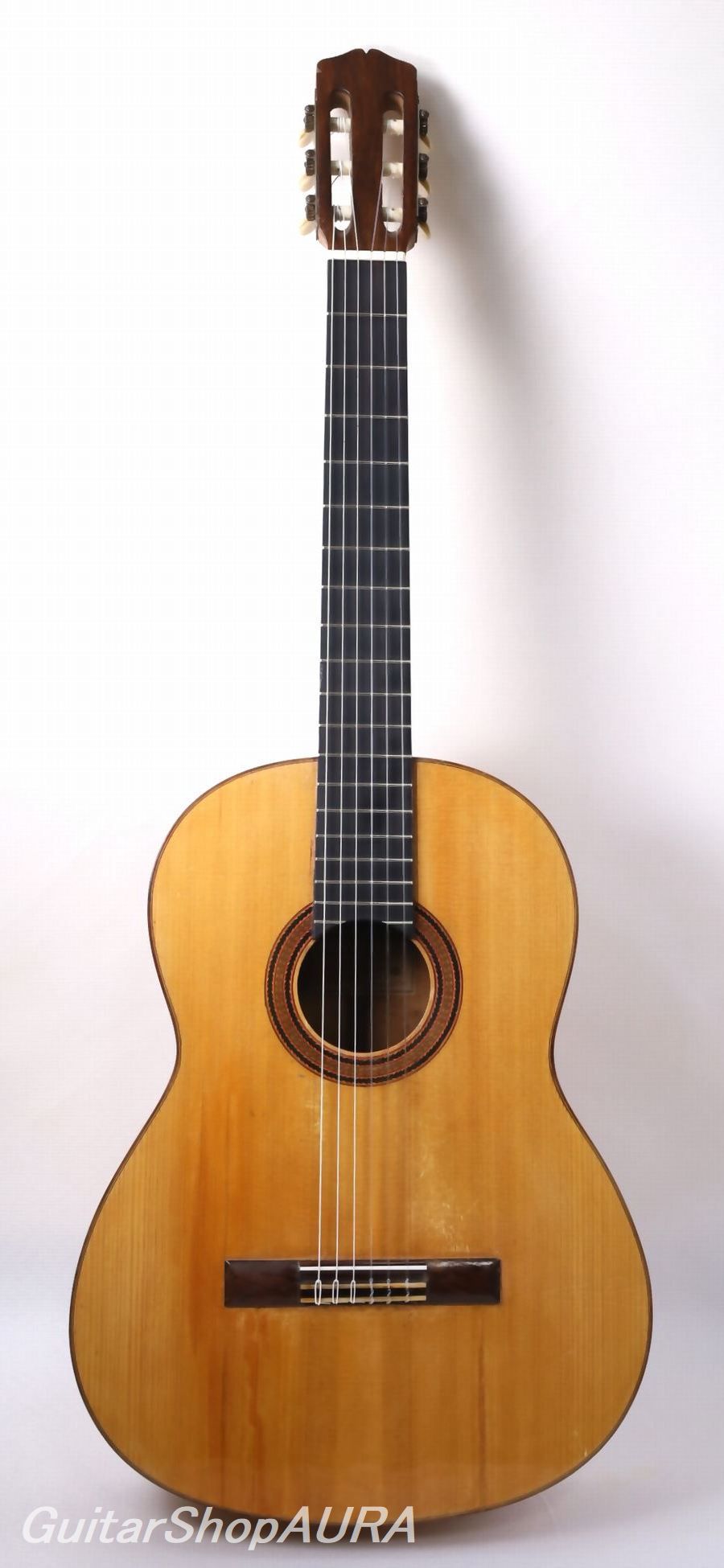
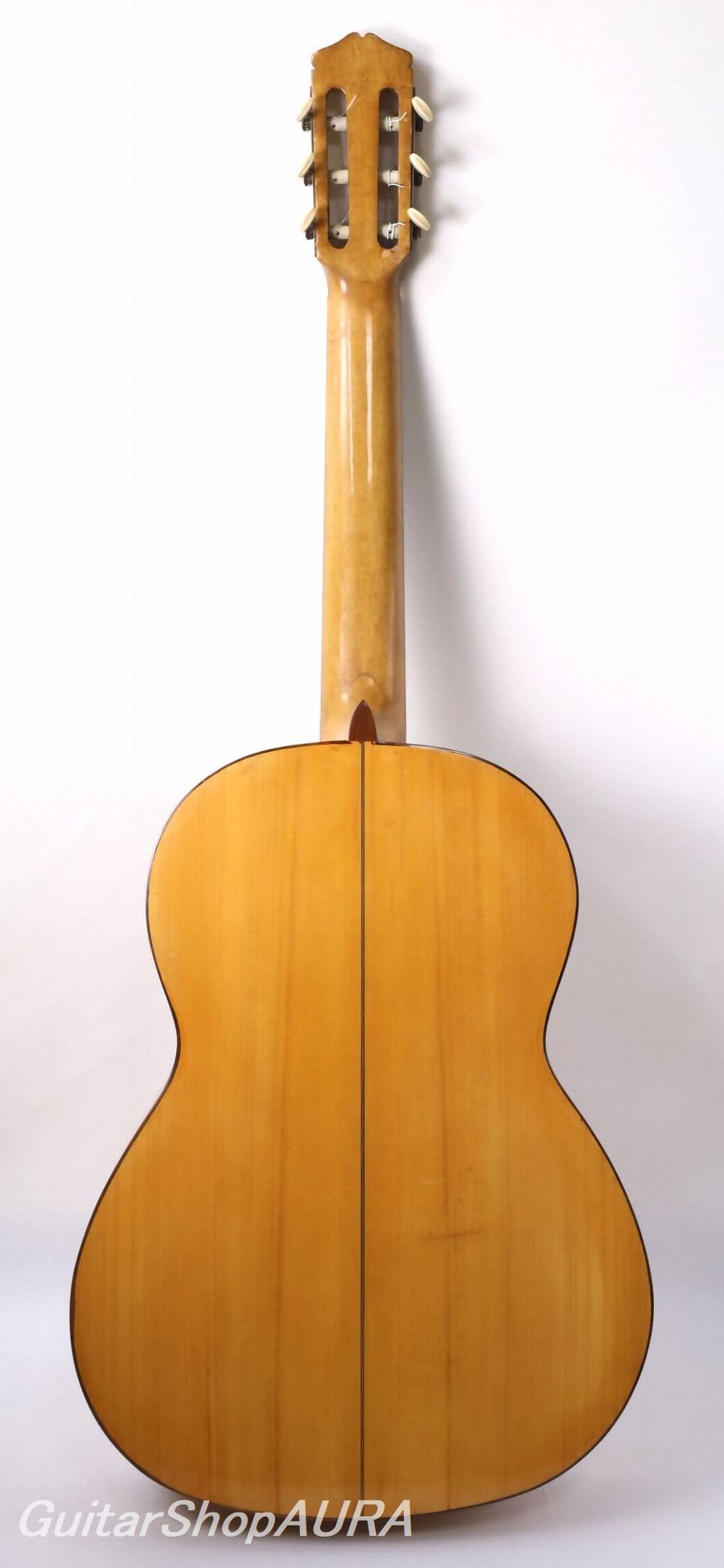
This guitar was built in 1930 by Modesto Borreguero. The cypress back and sides and internal structure indicate that it was originally built as a flamenco model, although the golpeadores have since been removed and the instrument is now suitable for both classical and flamenco playing.
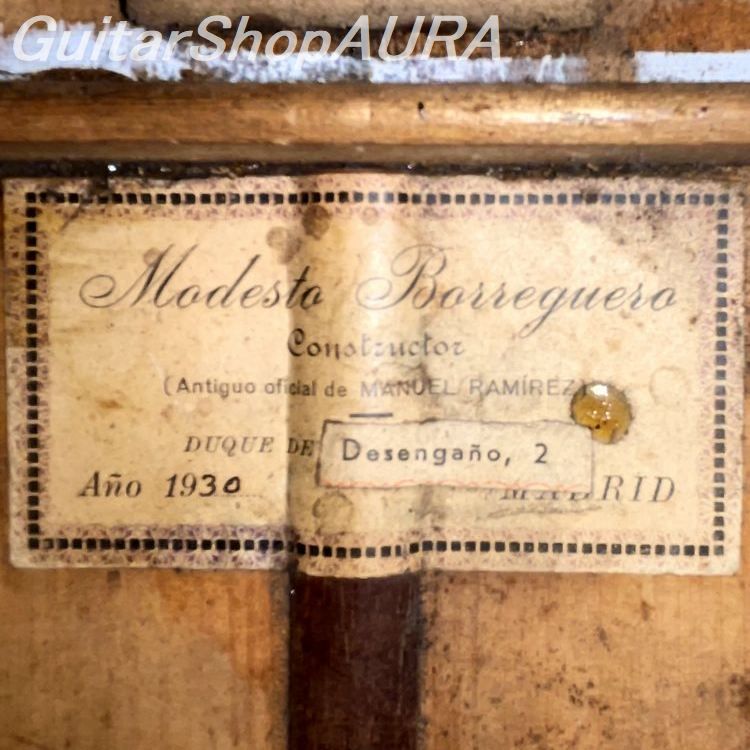
The label reads “Antigua oficial de Manuel Ramirez”, emphasizing Borreguero’s connection to the Ramírez workshop even after he had established himself independently. The label design itself also reflects the Ramírez tradition, while the workshop address was corrected with a small pasted label reading “Desengaño 2,” hinting at the frequent relocations he experienced during that unstable period of his life.
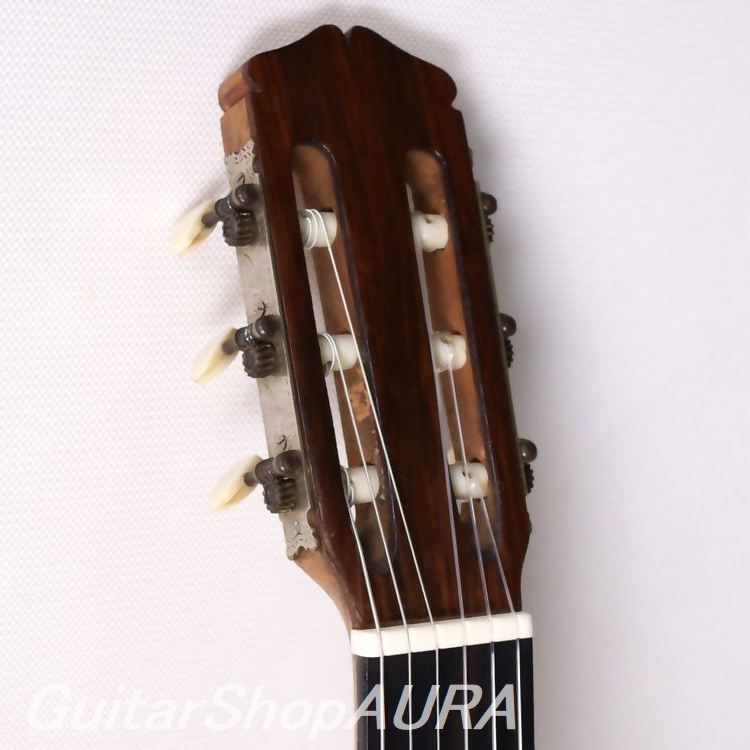
The construction clearly shows the influence of Santos Hernández, visible in the head shape, rosette design, and especially the bracing layout. The soundboard features harmonic bars above and below the soundhole, along with a thin reinforcement plate surrounding the rosette area. Five nearly parallel fan braces are arranged symmetrically in the center of the lower bout, while two closing bars at the bottom are set unusually far apart near the sides of the guitar.
This layout closely resembles the design later associated with Santos Hernández, Marcelo Barbero, and Arcángel Fernández, revealing a fascinating historical connection. The resonance is set slightly below F#.
Tonally, the guitar beautifully captures the essence of the pre-war Spanish guitar tradition. The bass is deep and focused, the lower midrange expressive and vocal, and the trebles bright, clear, and singing. The instrument produces a cohesive voice in which the entire body resonates as a unified whole. Individual notes are refined and clean, while chords, arpeggios, and rasgueado passages reveal excellent balance and clarity across the strings. The response is quick and lively, as expected from a traditional flamenco instrument.
Given its age and likely use as a working flamenco guitar, the instrument has undergone several repairs. There are multiple crack repairs on the soundboard and on the back and sides (including areas near the bridge, fingerboard edge, neck heel, and lower bout). The guitar has also been refinished in shellac, and the top shows some deformation around the bridge area due to age. The headstock has a repaired crack at the 6th-string tuner slot.
The neck remains straight and the frets are in good condition. Due to the slight deformation of the soundboard over time, the neck angle relative to the body is somewhat increased, resulting in a slightly higher action for a flamenco setup: 3.0 mm / 3.6 mm (1st / 6th string at the 12th fret). Saddle height remaining is approximately 0.5 mm.
The neck profile is a slim D-shape with a compact grip, and the guitar is remarkably light at 1.14 kg, contributing to its lively response and traditional flamenco feel.
〔detail〕
| Instrument | Modesto Borreguero |
| Category | 輸入クラシック オールド |
| Number/Model | |
| Scale length | 648mm |
| Country | Spain |
| Year | 1930Year |
| Top | Solid Spruce |
| Side&Back | Solid Cypress |
| Condition※ | 6 |
| List price | 時価 |
| Price (tax included) | お問い合わせ下さい。 |
| option | With Hardcase |
 Map & Access